Category Archives: Lessons Learned

Wally Pipp’ed Without Being Wally Pipp

The title of this story should be “Wally Pipp’ed without being Wally Pipp”—but to keep to the hockey theme, we’ll call it “The Unraveling of My Hockey Dream.”

I had always loved hockey, and when I discovered an opening for a camera operator with the local amateur team, I jumped at the chance. I believed that showing up early and doing the job would secure my spot—unlike Wally Pipp, who lost his position to Lou Gehrig for taking a day off. I was determined to avoid a similar fate.

The media relations guy welcomed me warmly, and I made it a point to arrive early every time, pouring my heart into each game. To feel like a true part of the team, I ordered their hat and shirt, ie. merchandise with the team logo. You could not buy them from the team directly but had to do so online from a third-party store. Little did I know that this small investment would lead to a nightmare. The store’s communication was poor; they insisted I download the “Shop” app to track shipping. Long story short, downloading that particular app—again, for the purpose of tracking the shipping—wrecked my phone, costing me $140 for a new one. By the time my gear finally arrived, my excitement had soured into frustration.

Then came the gut punch. Two weeks after I had received the merchandise, the media relations guy texted me, casually mentioning that the team management was bringing in a college student to take over the camera work. My heart sank. I had invested so much into this position, convinced that my dedication would pay off. Instead, I felt like a placeholder, just another face until someone else came along.

I couldn’t shake the words of a relative who had questioned my spending on the team’s merchandise: “You’re probably spending more than you’re making.” I had brushed it off at the time, thinking my passion justified the costs. But now, those words echoed in my mind, a bitter reminder of my misplaced priorities. The shirt and hat I wore with pride felt useless—tokens of a dream that had slipped away.

Disgusted and disheartened, I reflected on the experience. I was reminded of something I should have already known—it doesn’t matter if you show up early and do the job. It does not matter that you are fairly competent and reliable in the job. In other fields, in other workplaces, people often keep their jobs for showing up late, being incompetent, and being rude to customers. Life stinks, and sometimes it feels like everything you pour your heart into can crumble in an instant.

I had hoped to contribute to something I loved, but instead, I felt cast aside, much like Pipp, who had been replaced without a second thought.

As I packed away my team gear, I realized that passion alone wouldn’t secure my place in this world. I would need to find a new path, one where I could truly thrive—not just as a fan, but as someone whose dedication could lead to something meaningful. It was time to redefine my journey, seeking opportunities where my passion and effort could truly make a difference, ensuring I wouldn’t be left behind again.

Update: I’ve decided to give that store a one-star rating as a review.

Gotta find ways to feed yourself…

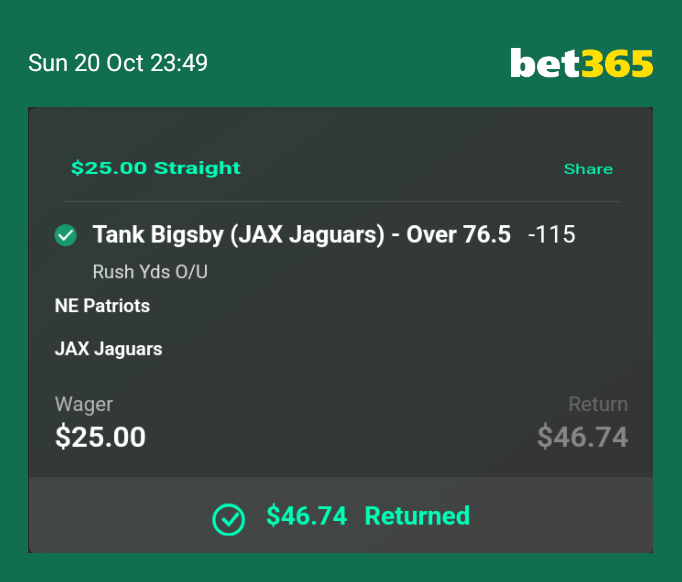
On Sunday night, I was tipped off to the fact that if the NY Jets fell behind any further — down 30-15 with seven minutes left in regulation against the Pittsburgh Steelers — they would likely pull all their starters. Or Pittsburgh might just run out the clock. Armed with that information, I did the following:

I can’t take the credit for this. Again, I was tipped off to the possibility of the Jets just giving up or not having the ball back for the rest of the game. So, I risked 30 bucks for a chance at a small profit.

But you gotta do what you gotta do to feed yourself. During the weekend, I was at the hockey rink doing play-by-play as a side gig. And during the intermissions and before the games, I had earphones in my ears listening to tips and live updates about college football, the NFL, and the NHL. Or after and before classes (yes, on the weekend), I stopped by at McDonald’s for a couple hours to again do the same thing, listening to tips and live updates so that I could make smart investments. (Yes, I ordered food while staying there, unlike some who use these places as their “offices” without ordering anything. And yes, like I said, I had earphones, unlike many inconsiderate people who play their stuff loudly without any earphones to annoy others around them. Jerks.)

Again, you gotta do what you gotta do.

Thanks to listening to tips and live updates, I was 3-0 in the three Sunday NHL games: Winnipeg Jets to win by exactly 3 goals vs. Pittsburgh Penguins (ahhh, another “Jets/Pittsburgh” matchup), Winnipeg to beat Pittsburgh by the correct score of 6-3, LA Kings to beat Anaheim by more than 2.5 goals, and Colorado to beat the Sharks by the correct score of 4-1. These were taken with about five minutes left in each game. There were some misses in the NFL, unfortunately, but you can’t win all your investments. Got burned by the two late TDs in the KC/49ers game. The rest, though, were pretty good. (Again, I was tipped off to most of these situations.)

Ultimately, there were more than 100 picks made for the entire weekend, and I came out on the plus side, but although I tracked them, it’d be impossible to post them all here. Will have to try again for Monday Night Football (two games), Tuesday hockey, and Thursday Night Football and hockey, and see what happens.

You gotta do what you gotta do.

People just like knocking me down

I had a great conversation with Michael Unger (@UDeck1990 on X) about his baseball card postings on social media; it was a wonderful discussion about baseball players from the 1990s.

While that was a great discussion, as I mentioned during the episode, people are vicious if they don’t agree with you.

There’s an example of a situation with a coworker many years ago, when I mentioned that a certain player (who made his major-league debut in that same decade of the 1990s) was overrated. That player happened to be my coworker’s favourite players — or at least one of his favourites. This was an in-person comment that I made when we were discussing baseball.

The coworker began targeting me ever since, for the duration of my time in that organization. First, he sent me a lengthy email stating why I was wrong and why that player was not overrated. Then he just stopped cooperating with me at work. He eventually attempted to get me fired, coming up with a devious scheme.

I left that organization shortly after, but I’m better for it. It was a toxic environment and not just because of that coworker. Management was incompetent, for the most part, and did not appreciate hard work. They appreciated those who kissed asses while not working hard or working smart.

After leaving, I went through a period where I became productive with other projects and also learned who my friends were and who weren’t. I reached out to some “friends” and lamented that I had left my company — and most of them never contacted me again. They cut me off, cut me out, because — apparently — they thought I was a lowlife who didn’t have a job.

But I was productive in other areas, and I’m proud of some of the things I did during that time.

Anyway, that’s just one story. And this one started because I made a comment about a baseball player (who, incidentally, has already passed away) that the coworker liked.

Seriously?

Like I said, people are vicious. They just are.

(Note: The player whom I said was overrated had the same pitching style as another pitcher that I mentioned in the podcast, but I won’t say that deceased player’s name.)

Sports Book Writing Chronicles: Experiences and Lessons Learned, Part 1

By K.P. Wee

(A condensed version of this appeared in the IBBWA newsletter back in August 2024.)

It’s not often that I am asked to share my writing experiences, so when an industry contact recently inquired, I decided to take the opportunity to review and reflect on my writing journey. 

This process of reflection is significant to me, as it allows me to appreciate how far I’ve come and to recognize the challenges I’ve faced along the way. Reflecting on these experiences not only provides a sense of accomplishment but also helps me understand the hurdles and successes that have shaped my career.

Although my current work involves doing play-by-play commentary for minor hockey games and teaching, my journey into writing was quite different from what I am doing now. In the past, I wasn’t very comfortable with public speaking. I often found myself struggling to articulate my thoughts clearly in front of an audience. This discomfort with verbal expression led me to discover a different strength: writing. I realized that I was much better at expressing my thoughts and ideas through the written word. Since I have had a passion for sports since my teenage years, writing about them was both enjoyable and fulfilling. It provided me with a platform to channel my enthusiasm and knowledge into something tangible.

I came to the conclusion early on that I wasn’t adept at debating sports topics with others. Discussions about sports often seemed pointless because I would find myself in heated arguments without convincing the other person or even being able to present my thoughts coherently. This realization made me turn to writing as an alternative. Instead of engaging in often fruitless debates, I chose to write about sports on my own computer. This solitary pursuit allowed me to delve deeply into my interests without the constraints of immediate feedback or opposition. Writing about sports became a more natural and satisfying way for me to engage with my passion.

A significant turning point in my writing journey came when I was inspired by a gap in the literature. I thought, “There are so many books about baseball. I’m sure I can write books too.” This realization stemmed from my frustration that one of my favorite baseball pitchers growing up, Tom Candiotti, was never featured in any of the baseball books I found. Tom, known as the “Candy Man,” had an impressive career despite being undrafted, and was renowned for his mastery of the knuckleball (and curveball). In the late 1990s, he mentioned on his website that he was planning to release a book about the knuckleball—a pitch he excelled at during his remarkable 16-year career.

Unfortunately, that book never materialized. This absence of a comprehensive account of Tom’s career sparked a thought: “Why don’t I write a book about him instead?” Motivated by this idea and fueled by my admiration for Tom’s baseball career, I dedicated years to researching and writing about him. The culmination of this effort was the publication of Tom Candiotti: A Life of Knuckleballs in 2014 by McFarland & Co. 

This achievement was a significant milestone in my writing career. It marked the beginning of a continuous journey in sports writing and opened up new opportunities for me to explore different aspects of the sports world.

After completing the first book, I quickly realized that the writing process was ongoing and involved numerous challenges. The journey, while rewarding, can be quite exhausting. To succeed in writing, you need to be motivated and passionate about what you’re working on. Additionally, finding time to write amidst various life responsibilities is crucial. Balancing writing with other commitments, such as work and personal life, can be demanding, and maintaining motivation is essential for progress.

Many people might assume that the COVID-19 pandemic was the ideal time for writers because everyone was at home with ample time to focus on their writing projects. For me, however, it was quite the opposite. Prior to the pandemic, I often found myself writing in local coffee shops, where the bustling environment provided a different kind of inspiration. Seeing university and college students working on their school projects in these coffee shops became a source of motivation for me. I felt a strong desire to produce outstanding work that would surpass the quality of their business or science projects. Their presence, even though I never interacted with them directly, was enough to push me to improve my writing and strive for excellence.

When COVID-19 disrupted all my routines, I struggled to stay focused and maintain productivity. To overcome this challenge, I developed a strategy to keep myself engaged with my writing. I downloaded numerous MLB Network documentaries and NFL Top 10 videos from YouTube and played them on a continuous loop while working. This approach helped me stay connected to the sports world and provided a backdrop of inspiration, particularly when I was finishing my book about Barry Bonds. The repetitive viewing of these videos kept me motivated and engaged, allowing me to make steady progress on my writing projects.

Another significant challenge in writing sports books is finding appropriate photos. Many readers may not realize the difficulties involved in securing high-quality images for publication. When pitching my books to publishers such as McFarland & Co. and Rowman & Littlefield, I was informed that I would need to find and pay for the photos myself. While Rowman & Littlefield covered the cost of the cover photo for The 1988 Dodgers: Reliving the Championship Season, I was responsible for securing and financing the interior photos. This aspect of the publishing process added another layer of complexity to the writing journey.

When approaching different major-league teams, I found that not every club handled photo requests the same way. There was one particular major-league team that charged exorbitant fees for photo usage—I was quoted a price of thousands of dollars per image, which was well beyond my budget. So, I declined. On the other hand, some teams provided photos for free, as long as I gave proper credit. Unfortunately, there were also teams that did not respond to my requests at all. This variability in how teams handle photo requests created additional hurdles in the publication process.

Here’s yet another example of the challenge of obtaining photos that is often not apparent to readers. I once approached a freelance photographer about photo fees, but his response was snotty and condescending. His attitude discouraged me from pursuing this option further. 

So, for those who are unaware, securing photos for a sports book often involves navigating a complex web of permissions, fees, and varying levels of cooperation from different organizations.

There are also times when expected sources for photos don’t have what you need. For instance, while writing The End of the Montreal Jinx—a book about the NHL rivalry between the Boston Bruins and Montreal Canadiens from 1988 to 1994—I contacted the Hockey Hall of Fame for photos of these teams from the 1990s. However, they were in the process of transferring their archives and couldn’t provide the images I required. As a result, I had to rely on photos from the 1970s and random images from the 1980s and 1990s sourced from a collector who had the rights to those photos. Although this solution worked to some extent, it was not ideal. Later, after the book was published, I found the photos I needed on the Hall of Fame’s website, but it was too late to make any changes.

Support, or the lack thereof, can also be a challenge in the writing process. When discussing my work with others, I sometimes encounter dismissive responses. For example, when I mentioned to a “friend” that I was writing about the 1993 Montreal Canadiens to mark the 25th anniversary of their last championship, the response was a patronizing “So what?” as if to imply, “And? It’s a dumb idea.” Such reactions can be disheartening and demotivating. When I attempted to defend my work and explain its significance, the “friend” was offended and distanced himself from me. Another time, a boss asked me what I was working on. I mentioned the inspirational story about Candiotti’s being the second player ever to come back from Tommy John surgery—which again drew a patronizing “So what?” 

These experiences highlight the challenges of seeking validation and support for creative endeavors.

Occasionally, a “friend” might ask in a condescending manner, “How much money can you make from THIS?” I find that questioning someone’s income or the financial aspects of their creative pursuits is impolite. Yet, it is a question I encounter from time to time. I am tempted to respond with, “And how much money do you make from smoking marijuana, drinking, and pursuing your other harmful and addictive hobbies?” but I refrain from doing so. Such questions reveal a lack of understanding and respect for the value of creative work.

These experiences are all part of the journey. They highlight the challenges and triumphs that come with pursuing a passion for writing. This account represents just the first part of many stories I have to share about my writing journey. I look forward to providing more insights and reflections in the future, as I continue to navigate the ups and downs of being a writer in the world of sports.

Okay, I didn’t take a break…

Okay, last night I said I’d take a break from the sports investments, but I did play WNBA games…

Took the Sky +14.0 pregame, and then took their ML when up 75-72 and then minutes later up by one point. Good numbers…

Design a site like this with WordPress.com
Get started