Category Archives: Lessons Learned
Life: Avoid negative people…
It’s important in life to surround yourself with mentors who could help you, while at the same time, offer assistance and guidance to those that seem to need it. It’s about give and take in life.
It’s equally important to not spend so much time with those that are negative and have no ambition in life, or people that just don’t want to talk to you, because these folks just suck the positive energy out of you.
There’s an acquaintance that I have who recently told me that she wished we could talk more regularly like we had in the past. I think what happened was I found that we had very little in common in terms of interests and hobbies, and we gradually stopped talking. However, she wanted to continue talking again. No problem. I’m always willing to make friends and help those who could learn from my experiences, so I have been doing my part recently. Just the other day, I asked this particular individual through a communication app what her goals were for 2015, hoping to have a meaningful and relevant conversation.

Now, you may not understand Chinese, so let me recap what happened in the conversation. I asked what her goals were for 2015, and her response was a very cryptic “Don’t have” or “No.” Being someone who likes to encourage people, I offered the following response: “Really?” with an emoticon. I mean, it’s possible that it was a question that was too personal, but nonetheless, I didn’t feel like it was an inappropriate question.
 After more than 10 minutes without another response from her, I added a smiley face and then a sarcastic comment that read, “Oh, [her name] has goals but does not wish to share them with me. Okay.” I mean, again, it was meant to elicit a response. If she was busy and couldn’t reply, she could have just stated that. After all, she had wanted to resume communicating regularly again, so I was trying to do my part.
Her follow-up response was again a short answer, which read, “No goals.” Now, at this point, the average person might be put off by the lazy, short answers. If not, surely one might be put off by the fact that she seemed unenthusiastic about the new year and really has no goals. I mean, that’s kind of a major turn-off if you think about it. Either she does not want to communicate and put no effort into typing, or she has no ambitions in life (!!!!!) even though many people are excited about New Year’s, or both.
Now, I like to give people the benefit of the doubt, and I casually replied, “Oh. It seems you don’t like to write much these days. Okay, then no problem.”
Then this was what happened:
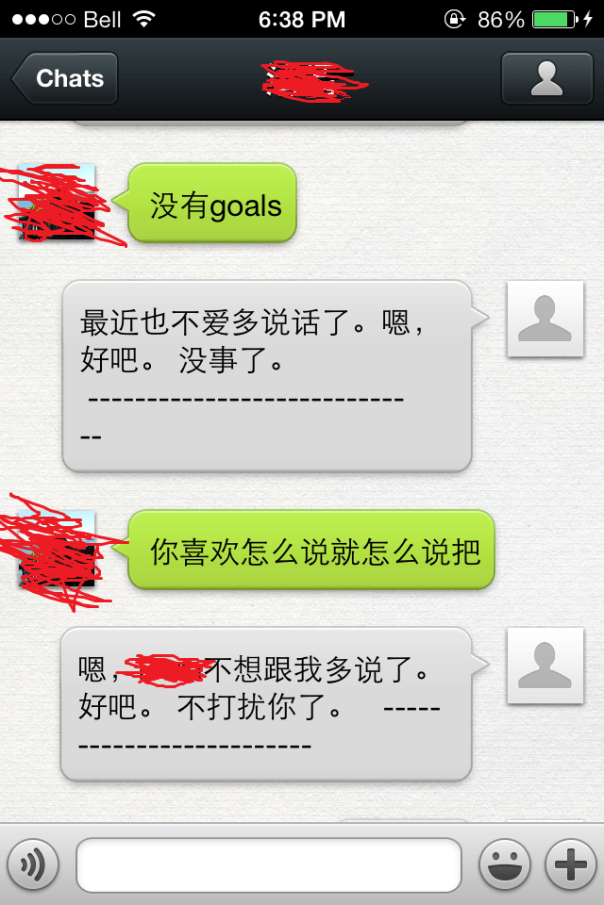
This time, she replied right away, with a much longer sentence, but not a friendly one. The response was, “If that’s what you want to say, so be it.”
Wow. What a response. Clearly, she was having a bad day (?!) or she was being hostile for some reason. Whatever the case, I decided to drop it, and wrote, “Okay. [Her name] does not wish to say anything further. All right. I will not bother you now.”
That was the end of the conversation, and she did not write anything further.
Now, a few things:
1. Yes, I am more fluent in English and I prefer conversing in this language. However, this acquaintance is more comfortable using Chinese, which I have no problem with because I can read Chinese as well and type it too. So, it’s not an issue with language. If she could not express her goals or thoughts in English, she could have typed in Chinese and I would have understood her. Since we’d talked many times before, she knew about my fluency in Chinese.
2. If she didn’t have time to chat with me at that time, she could have said so instead of typing those short answers, which, to be perfectly honest, shows how lazy a person is – or worse, that person does not want to make the effort to properly communicate with you. Short answers like that, like “No” or “No goals” without any other details, are just huge turn-offs.
3. If that question about goals for 2015 was inappropriate and the person genuinely wants to talk to me as she’d indicated previously, then she should have suggested discussing a different topic.
4. Really, the way that the person wrote her responses…it just makes her look rude and uneducated. If she was having a bad day and did not wish to chat at that moment, she could have just said so. If there was any issue, then just talk about it so we could work through them, or if there was anything I could do to help, just say so. But being rude is not acceptable.
There are no excuses for this person’s behaviour. Having to deal with this on a consistent basis is simply meaningless. Here I am, trying to encourage this individual by getting her excited about the new year and positive goals, and her answers just suck the energy out of you. It’s like this person really has no goals or enthusiasm. No sense to spend that much time talking to such people. People that give attitude without any reason are simply not worth the time, because in life you want to strive to improve all the time and talking to someone who has no interest in that only serves to drag you down and onto their level.
Avoid these types of people – cut them out of your life if possible – and focus on communicating with those who are more positive and have more to contribute to a meaningful discussion.
Life: What does it mean to help people?
Here’s something to think about: What does it mean to help people? What makes you helpful?
True story: This guy once Googled a few workout videos and sent those links via email to a few of us, and in that email he wrote, “Everyone, here’s the October workout schedule for you all. Let’s all follow this for a whole month!” I replied saying I wasn’t interested in it, that I was okay with how I was and wouldn’t be following that schedule. His response? Something along the lines of, “I’m trying to help you and you don’t want to accept. I don’t care anymore because you act as though you’re 100% satisfied with your life.” [He also took a few more personal shots, saying things like, “When people don’t need my help, I just move on and go help others who need me. Not going to waste time (with you).”]
 Just because I stated I was okay with my daily routine, the guy interpreted it as me saying I was completely happy with my life, which isn’t the same thing, but I digress. He also used the words “I don’t care,” which people seem to throw around and use very, very loosely. I mean, he considered “help” as giving one-size-fits-all “solutions” to a group of people, as though each person’s situation is exactly the same and would benefit from the exact same “solution.” This isn’t a multiple-choice test or a short-answer quiz, or a math problem, where everyone arrives at the same answer from what the teacher gives you! This is real life, and sure, the guy was kind enough to share those videos, but then to turn around and act all insulted when I didn’t want to participate, was a bit over the top. Saying things like “I don’t care anymore” and turning hostile were simply unnecessary. You’ve got to understand your “audience,” so to speak, if you want to “help” them. Giving a bunch of tough workout exercises to people ranging from fitness freaks (some of the others) to beginners (myself) and expecting all parties to benefit from the exact same schedule, was presumptuous (not to mention unrealistic). Sure, offer them as a suggested schedule, but don’t shove them down people’s throats. And certainly don’t get all pissed off when one person politely declines.
I think the key is to not shove something down people’s throats. Of course, don’t act all insulted as well when your suggestions are not well received. The proper attitude is, “Hey, if one person – just one person – can benefit from what I told them, then I’ve done my job.” If you want to help people, THAT’s the attitude to have.
Recently, I travelled from Vancouver, Canada, to Dayton, Ohio, because I was invited to speak to a class of engineering students at the University of Dayton. I was asked to share my experiences about a specific topic which could be helpful to the students. I approached the lecture the same way: “These are my experiences, and what I went through personally. If what I say could help just one person, then I’m glad to have helped that individual through my words. I’m certainly not going to shove my ideas down people’s throats and expect them all to follow what I tell them. My experiences, my words, etc., might be helpful to some and irrelevant to others. That’s reality. Just aim to have at least one person benefit from what I tell them. That would make me very happy and proud.”
Simple. That’s genuine help. It’s not about converting people or shoving ideas at people. It’s about detailing solutions that have helped me in my life and sharing them.
Other people will consider those who alert them about sales at high-end stores, etc., as “helpful” human beings. Hey, so-and-so was so kind to tell me that this [insert name of expensive brand] handbag was on sale. So-and-so is so wonderful and “helpful”! Yay! So-and-so gave me a coupon for Domino’s pizza that entitles me to eat at one of their locations at such-and-such a percent off! So “helpful”! Uhm. No. I couldn’t disagree more. But then again, that’s my personal opinion and I wouldn’t shove it down your throat either.
What have you learned today?
(Originally posted on Quora)
I learned today that if I wake up early in the morning, I can get more things done [1]. I can be more productive that way if I get up two-and-a-half hours earlier than normal instead of sleeping in.
The time difference might not sound significant, but it actually is. Let’s say that I woke up today right after 9:00 as opposed to 6:30-ish. That’s nearly three hours of wasted time that I can never get back – and in that time I could be doing a lot of things.
For instance, early this morning I was able to accomplish the following:
- communicated with a couple of important people from two different publishing companies,
- worked out a deal with a contact in Vancouver regarding some cross-promoting stuff that benefits both parties,
- planted the seeds for some research on a book I’m writing,
- replied back to seven important emails,
- sent an email to a friend in Asia,
- checked some information on my bank account,
- updated my budget for July,
- sent a copy of my e-book to a contact in Michigan by email,
- responded to a time-sensitive email from an eBay seller regarding an item that a family member had ordered through my account, and
- updated my Quora profile and a couple of things on my websites.
I’m sure there were some other things that I’ve probably left out.
I did all of these things after I had arrived at the office a half-hour early. And yes, I ate breakfast and took a shower before leaving the house, and did everything listed above in the half hour before starting my work shift. After all of that, then I began my shift right on time.
So, what I learned today is I can be productive by not sleeping in – even if 9:00 isn’t really considered “late” in North America. If I didn’t get up early, who knows when I would have had the time to get those things accomplished?
[1] Recently, I have been working 12 noon shifts which means I normally wake up at 9 am. Today, I’m working an 8 am shift so I got up at 6:30.
What 5 rules would help me become successful if I applied them to my life?
(Originally posted on Quora)
Original Question:
Psychology: What 5 rules would help me become successful if I applied them to my life? I’m not looking for specifics such as brush your teeth, I’m looking for more interesting principles that can be applied to a variety of situations.
Here are the top five rules to help you succeed:
1. Compare yourself with yourself, not with your friends / neighbours / colleagues. It simply isn’t worth your time to compare what you have and your results to what other people have and have accomplished. There are always going to be people ahead of you, no matter what. That doesn’t mean you’re not good enough. What it means is you should be focusing on yourself and on your own accomplishments. How have you improved compared to a year ago today? How will you continue to improve next week? What will you do so that you can be even better five years from today?
2. Learn how to be a good conversationalist. One rule that many people believe in for starting a conversation is you have to appear friendly. Don’t try to impress people right away when you start the conversation. What you want to do is show you’re a relaxed, friendly, sociable person who wants to have a pleasant chat.
One skill to keep in mind in being a good conversationalist is the ability to ask open-ended questions (not the simple “yes” or “no” questions but the ones where the other person has to give long answers). Also, you sound boring if you are asking typical questions like “What do you do?” or “Where do you work?” Ask different types of questions.
One of my bosses once taught me that you pay attention to the person’s interests so that you can build a rapport when you start a conversation. For example, before a job interview, he reads through the candidate’s resume and perhaps notices a certain hobby that the person has. During the interview, this boss would make the candidate feel relaxed by asking about that hobby and make the conversation interesting and not stressful.
3. Do not be afraid of failure. Actually, don’t even call it “failure.” Instead, label it as feedback and as a natural part of a successful life. Even the most successful people in the world have had their fair share of “failures” (oops I meant “feedback”) but they always keep bouncing back and try to learn from those experiences.
As former NBA great Michael Jordan once said: “I’ve missed more than 9,000 shots in my career… Twenty-six times, I’ve been trusted to take the game-winning shot and missed. I’ve failed over and over and over again in my life. And that is why I succeed.”
The important thing is to find valuable lesson learned every time you didn’t succeed in something. Ask yourself: What can I learn from this?
4. Always try to learn new things to improve yourself. There are always new skills and knowledge you can learn through the Internet. Instead of focusing on time-wasting habits (such as too many hours on video games / iPhone games / gossiping / TV shows), spend more time to pick up new things. You never know, these might be helpful when you are applying for a job. Let’s say the interviewer looks at the resumes of you and three other candidates, and all of you seem to have the exact same educational background and experience. If you have a certain skill that other candidates don’t, that might set you apart from the others if everything else is equal.
5. Know what you want and work toward achieving it. I’ll use career as an example, although this can apply to other areas such as relationships. But let’s focus on career here. The reality is that you have to take responsibility for your own professional development. Nobody is going to help you on your path toward your career goal, except for yourself. So, it’s up to you to understand what you want, why you want it, and be prepared to take action to make it happen. Don’t be passive about it or the opportunities will be missed.
Good luck!


 k. p. wee